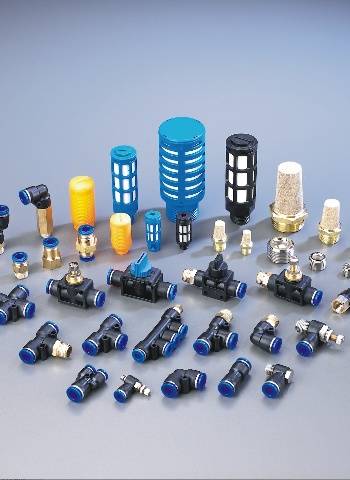
On almost any automated line, the quickest thing to install is also the most misunderstood. Push-to-connect fittings - also called one-touch or push-in fittings - join tubing to valves, cylinders and manifolds with nothing more than your fingers. Push the tube in, feel it seat, move on to the next one.
We have been manufacturing these fittings at our plant in Liushi, Yueqing since 2006, and we still see the same handful of mistakes causing leaks in the field. Almost none of them are the fitting's fault. They come from not knowing what is actually happening inside that small brass body.
So let's open one up.
Inside the Body: Three Parts, Three Different Jobs
Cut a quick fit fitting lengthwise and you will find three functional zones stacked end to end. Each one solves a different mechanical problem, which is precisely why they are built as separate parts rather than a single piece.
|
Part |
What It Does |
Material We Use |
|
Collet (gripping claw) |
Bites into the tube's outer surface and resists pull-out |
Stainless steel |
|
O-ring |
Forms the actual air seal against the tube OD |
NBR as standard |
|
Body and release sleeve |
Holds the assembly to the port, and opens the collet when you want the tube out |
Nickel-plated brass or PBT |
Here is the point that explains most field confusion: the collet grips, the O-ring seals. Two separate jobs, two separate parts. A fitting with a damaged O-ring will still hold a tube perfectly at zero pressure, then leak the moment air is applied. We have seen maintenance teams replace perfectly good fittings for weeks before someone checked the seal.
Why the Grip Gets Tighter as Pressure Rises
The collet is a thin stainless ring with inward-angled teeth. Push a tube in and those teeth are forced outward against a taper inside the body bore. Once the tube is seated, the teeth spring back and bite into the tube wall.
Then something useful happens. System pressure pushes the tube outward, and that outward force wedges the collet teeth harder against the taper. The joint is self-energising - the more pressure you apply, the more firmly the tube is held. No springs, no threads, no torque to set.
This is why a correctly sized fitting does not blow tubes out at normal working pressures. The tube is not being held by friction alone; the system's own pressure is doing the clamping.
What Happens When You Push the Tube In
The tube passes through the release sleeve. This sleeve is an actuator, not a seal - it touches nothing yet.
The tube deflects the collet teeth outward against the body taper, opening a path.
The teeth spring back and bite. You feel a distinct click.
The tube seats against the internal stop. On most sizes this is around 15–20 mm of insertion depth.
The O-ring compresses against the tube's outer diameter. This is where the air is actually stopped.
Pressure builds, the tube pushes back against the collet, and the grip tightens.
To disconnect, press the release sleeve toward the body. The collet teeth slide off the taper and open, and the tube pulls straight out - no twisting, no damage, and the fitting is ready to use again.
Step Four Is Where Most Installations Go Wrong
In our experience, the single largest cause of leaks at push-in fittings is a tube that was never cut square. An angled cut does not seat evenly against the O-ring, so the seal compresses on one side only. The result is a slow weep - frequently audible only at low pressure, which makes it genuinely difficult to trace once the line is running at full pressure.
A craft knife or a pair of side cutters will almost always produce an angled or distorted end. A dedicated tube cutter costs very little and eliminates the problem entirely.
The other three common causes, in rough order of frequency:
|
What Went Wrong |
Why It Leaks |
|
Burr on the tube end |
A burr on the inner or outer edge scratches the O-ring as the tube slides past, leaving a permanent leak path. |
|
Tube not fully inserted |
The O-ring only contacts a small band of tube. It may hold at low pressure and fail under load. |
|
Wrong tube or thread size |
Metric and inch tubing are separate dimensional systems, and BSP and NPT threads look nearly identical while using different pitches and tapers. Forcing the wrong pairing damages both and produces a leak that is very hard to find. |
Matching the Seal to the Medium
Specifiers tend to focus on the body material and treat the O-ring as an afterthought. In practice the seal compound usually sets the real operating limit, and it is the first thing to fail when the wrong one is chosen.
|
Compound |
Suited To |
Approximate Range |
|
NBR |
Compressed air, water, common machine fluids - our standard supply |
−20 °C to +80 °C |
|
FKM |
Heat, oils, many aggressive chemicals |
−20 °C to +200 °C |
|
EPDM |
Steam, hot water, ozone exposure |
−40 °C to +150 °C |
|
FFKM |
The harshest chemical service |
−20 °C to +300 °C |
Choose an incompatible elastomer and the seal will swell or harden and begin leaking long before any metal part shows wear. For food, beverage and pharmaceutical lines, specify a compliant compound explicitly rather than assuming the standard NBR is acceptable.
Body Material: Driven by the Environment, Not the Pressure
|
Material |
Behaviour |
Where It Belongs |
|
Nickel-plated brass |
Strong, machinable into every geometry, resists corrosion in ordinary factory air |
The general-purpose choice, up to roughly 14 bar |
|
PBT resin |
Light, economical, electrically non-conductive |
The 10 bar air class; humid or mildly corrosive atmospheres |
|
316 stainless steel |
Excellent corrosion resistance at a significant cost premium |
Washdown food plants, marine, chemical and coastal sites |
What usually decides this is not the working pressure but the ambient conditions - washdown, salt air, chemical splash. Pressure only matters when you are pushing past the standard range.
Choosing the Right Configuration
One of the practical advantages of this design is that only the body geometry changes while the grip and sealing mechanism stays the same, so a single tube size can be routed any way the panel requires.
|
Type |
Typical Use |
|
Straight union |
Tube-to-tube connections, extending runs or splicing |
|
Male / female straight |
Tubing to valve, cylinder, FRL or manifold ports |
|
Elbow (90°) and long elbow |
Direction changes at components, tight panel layouts |
|
Tee and branch Y |
Splitting one air source into two or more outlets |
|
Reducer |
Joining two different tube sizes in one circuit |
|
Control valve fitting |
Reducing pressure from a threaded port and releasing it at a set value, saving compressed air |
|
Plug / cap |
Sealing unused ports or isolating circuit sections |
Our standard range covers tube outside diameters from 4 mm to 16 mm across the common thread families, which between them account for the large majority of pneumatic panel requirements.
Four Things to Confirm Before You Order
Tube outside diameter. Push-in fittings are specified by tube OD, while hose barbs match hose ID. Measure with a caliper when there is any doubt - a near match is not a safe match.
Thread form and size. Verify with a gauge rather than by eye. Use BSPP where sealing is by a flat face or bonded washer, and BSPT where it is metal-to-metal on the taper.
Pressure and temperature limits, evaluated for the whole assembly rather than the fitting alone.
The medium and the ambient environment, which together determine both the body material and the seal compound.
Remember that in any assembled joint, the lowest-rated item sets the limit - tube, fitting, threaded port or accessory. A high-spec fitting on a low-spec tube is not a high-spec joint.
Keeping the Joint Reliable Over Time
Cut tubing square with a proper tube cutter, every time.
Inspect the tube end before inserting. If it is scored or oval, trim a fresh end - the fitting and collet are reusable across many cycles, but the tube end is the consumable.
Push straight and fully, until the tube seats against the internal stop.
Release the sleeve to disconnect. Never pull the tube out by force.
Keep fittings clear of dust, oil build-up and swarf, which compromise both the collet bite and the seal face.
Pressure-test after installation using your site's approved leak-detection method rather than relying on sound alone.
Why Small Components Decide Long-Term Air Costs
Compressed air is one of the most expensive utilities in any plant, and leaks are its largest hidden cost. A single poorly sealed joint can bleed air continuously for years, and the accumulated energy loss will comfortably exceed the price difference between a good fitting and a cheap one.
Where quality actually shows up is hard to see on a datasheet:
Collet teeth that keep their edge through repeated connect and disconnect cycles instead of rounding off and losing grip
Consistent O-ring compound and hardness, so the seal performs across its rated range rather than hardening early
Accurate thread geometry that seats correctly without cross-threading or excessive torque
Tight tolerance on the body bore, so the collet taper and O-ring groove work exactly as designed
This is the part of manufacturing that customers rarely see, and it is where we spend most of our time. Since 2006 we have built our production around injection moulding, automatic instrument and automatic assembly equipment at our facility in Liushi, Yueqing - a few kilometres from Wenzhou airport, in the industrial zone that supplies a large share of China's pneumatic components.
About AKS
AKS Pneumatic Components Co., Ltd. has been manufacturing pneumatic fittings, cylinders, solenoid valves, air source treatment units and mufflers since 2006. Our product range covers pneumatic quick fittings, mini and standard cylinders, solenoid and manual valves, FRL combinations and air treatment units, silencers, and PU tubing.
Our fittings are supplied to distributors, machine builders and OEMs, with established export markets across Italy, Germany, Turkey, India, Iran, Vietnam, Bangladesh, Dubai and beyond. Orders are supported by in-house tooling and assembly, so we can respond to both catalogue requirements and application-specific enquiries.
If you are specifying fittings for a new line, standardising components across an existing plant, or sourcing for distribution, our engineering team is glad to help you match the right fitting, seal compound and body material to the job.
Contact AKS - and build a pneumatic system that stays tight, cycle after cycle.
AKS Pneumatic Components Co., Ltd. · Yueqing, Zhejiang, China · Established 2006. This article is offered as general technical guidance; always refer to the product datasheet for pressure, temperature and media ratings applicable to your application.